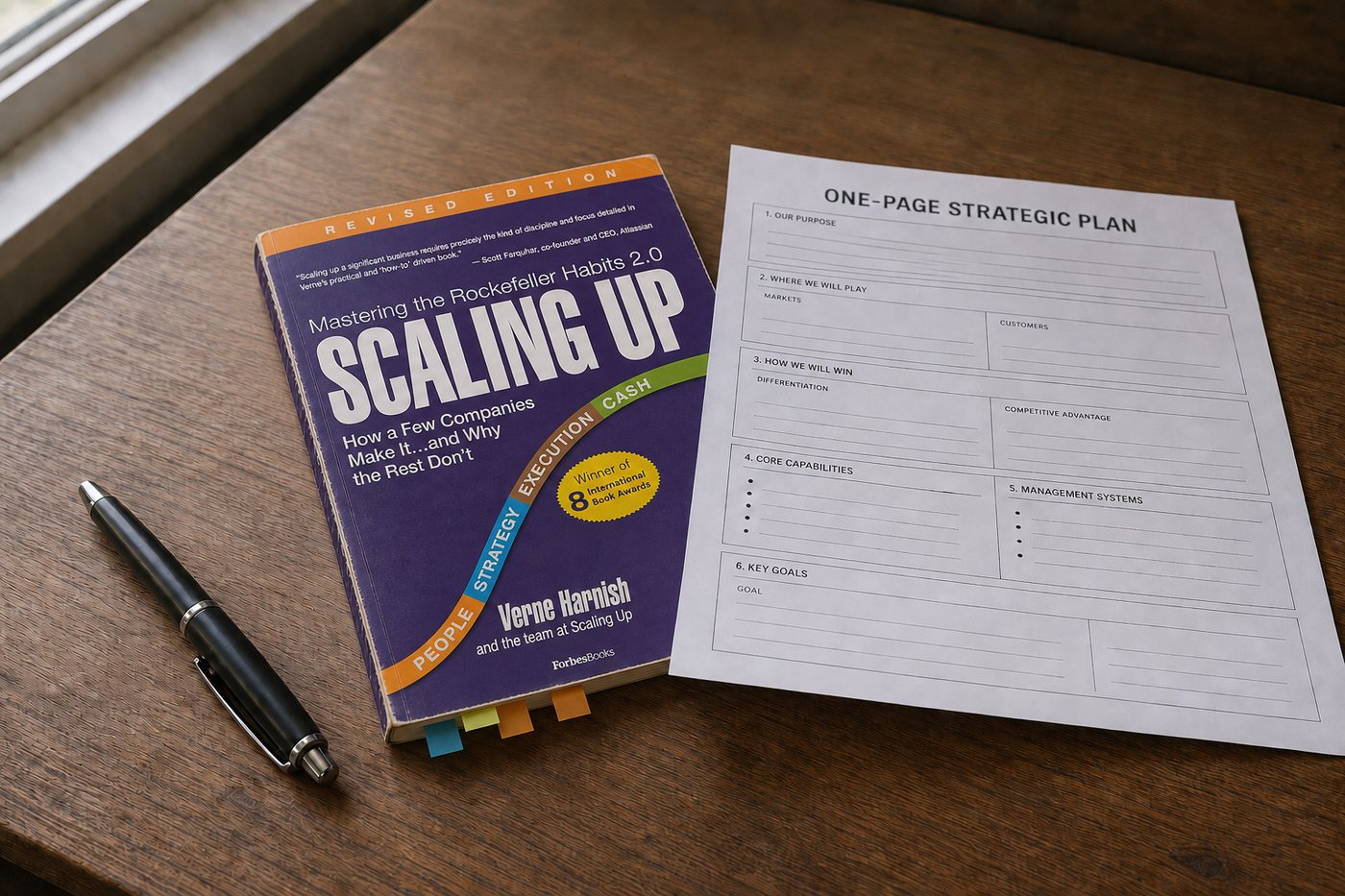
Why One-Page Planning Beats Complex Business Plans Every Time
Let me start with a story that might sound familiar. Last year, I met Sarah, who runs a digital marketing agency in Cape Town. She spent three months creating a comprehensive 40-page business plan. Beautiful charts, detailed financial projections, competitor analysis – all of that. But when I asked her what her top three priorities were for the next quarter, she couldn't answer.
That's the problem with traditional business planning. It's too complex, too static, and frankly, too overwhelming for the reality of running a growing business.
The Reality of South African SMEs
According to the 2024 FinScope MSME survey, over 70% of SMEs fail within their first five years. Not because they lack passion or market opportunity, but because they lack clear, actionable strategic direction.
Why Traditional Business Plans Fail
In our experience, traditional business plans fail for three main reasons:
- They're Too Long and Complex. When your strategy document is 50 pages long, nobody reads it. Not your team, not your investors, and honestly, probably not even you after the first month.
- They're Static Documents. Business moves fast, especially in South Africa's dynamic economy. A plan that takes months to update is useless when market conditions change weekly.
- They Focus on Planning, Not Execution. Most business plans are great at describing what you want to do but terrible at helping you actually do it. They're planning documents, not execution tools.
The One-Page Solution
The One-Page Strategic Plan, popularized by business scaling expert Verne Harnish, solves these problems by forcing you to distill your entire strategy onto a single page. This isn't about dumbing down your strategy – it's about clarifying it.
Think of it like this: if you can't explain your strategy on one page, you don't have a strategy. You have a collection of good intentions.
Complete One-Page Strategic Plan Template Breakdown
Let me walk you through each section of the One-Page Strategic Plan template. I'll explain what goes where and why it matters for your South African business.
Section 1: Core Values and Purpose
Core Values (3-5 Maximum) Your core values aren't marketing fluff – they're the behavioral standards that guide decision-making when you're not in the room. For South African businesses, this often includes values around transformation, community impact, and resilience.
Example for a Johannesburg-based logistics company:
- Ubuntu: We succeed together
- Reliability: We deliver on our promises
- Innovation: We find better ways
- Transformation: We build an inclusive future
Core Purpose This is your "why" – the reason your business exists beyond making money. It should inspire your team and resonate with your customers.
Example: "To connect South African businesses with global opportunities through reliable, innovative logistics solutions."
Section 2: 10-Year Target and 3-Year Picture
10-Year Target (BHAG - Big Hairy Audacious Goal) This is your moonshot – ambitious enough to inspire, specific enough to measure. Verne Harnish calls this your "summit" – like climbing Everest, it's the ultimate destination that guides all your decisions.
Example: "To become the leading logistics provider for African SMEs expanding globally, facilitating R10 billion in trade annually."
3-Year Picture This is your base camp – a detailed snapshot of what your business looks like in three years. Be specific about revenue, team size, market position, and key capabilities.
Example: "R50 million annual revenue, 150 employees across 5 African countries, serving 500+ SME clients with end-to-end logistics solutions."
Section 3: One-Year Plan
Annual Theme Pick one word or phrase that captures your focus for the year. This becomes your rallying cry.
Examples:
- "Scale" (if you're ready to grow rapidly)
- "Systems" (if you need to build infrastructure)
- "Expansion" (if you're entering new markets)
Annual Priorities (3-5 Maximum) These are your big rocks for the year – the initiatives that will move you closest to your 3-year picture. Each priority should have a clear owner and success metric.
Example priorities for a growing software company:
- Launch mobile app (CTO, 10,000 downloads by Dec)
- Expand to Durban market (Sales Director, R5M new revenue)
- Achieve ISO certification (Operations Manager, certification by Q3)
Section 4: Quarterly Priorities
This is where strategy meets execution. Your quarterly priorities should directly support your annual priorities but be specific enough to drive daily action.
90-Day Focus Areas Break down your annual priorities into 90-day chunks. This creates urgency and allows for regular course correction.
Example Q1 priorities:
- Complete mobile app beta testing (50 users, 95% satisfaction)
- Hire Durban sales team (3 sales reps, 1 manager)
- Begin ISO documentation process (complete gap analysis)
Section 5: Key Performance Indicators
Leading vs Lagging Indicators Lagging indicators tell you what happened (revenue, profit). Leading indicators predict what will happen (pipeline, customer satisfaction, employee engagement).
For a South African consulting firm:
- Lagging: Monthly recurring revenue, client retention rate
- Leading: Proposal win rate, client satisfaction scores, referral rate
The Power of One
Verne Harnish's "Power of One" concept identifies seven financial levers that can dramatically impact your business. Focus on improving just one of these by 1% and watch the compound effect:
- Price (increase by 1%)
- Volume (sell 1% more units)
- Cost of goods sold (reduce by 1%)
- Operating expenses (reduce by 1%)
- Accounts receivable (collect 1% faster)
- Inventory (reduce by 1%)
- Accounts payable (pay 1% slower)
South African Business Example: TechSolutions Cape Town
Let me show you how this works in practice with a real example. TechSolutions (name changed for privacy) is a Cape Town-based software development company that implemented the One-Page Strategic Plan in 2024.
Before: The 40-Page Plan Problem
TechSolutions had a comprehensive business plan that covered everything from market analysis to detailed financial projections. The problem? Nobody looked at it. The team was working hard but not necessarily on the right things. Revenue was flat at R22 million annually, and employee turnover was high.
The One-Page Transformation
Here's their actual One-Page Strategic Plan (simplified):
- Core Values: Excellence in code, Client success first, Continuous learning, Ubuntu teamwork
- Core Purpose: "Empowering South African SMEs with world-class software solutions"
- 10-Year Target: "R100 million revenue, 200 employees, leading software house in Africa"
- 3-Year Picture: "R50 million revenue, 50 employees, 100+ SME clients, offices in 3 cities"
- Annual Theme: "SCALE"
- Annual Priorities: Launch SaaS product, Expand to Johannesburg, Achieve 95% client retention, Build world-class team
- Q1 Priorities: Complete SaaS beta with 20 clients, Hire Johannesburg team lead, Implement client success program, Launch employee development program
- Key Metrics: Leading: Pipeline value, client satisfaction, employee Net Promoter Score. Lagging: Monthly recurring revenue, profit margin, client retention
The Results
Within 18 months of implementing their One-Page Strategic Plan:
- Revenue grew from R22 million to R36 million
- Employee satisfaction increased from 65% to 88%
- Client retention improved from 78% to 94%
- They successfully launched their SaaS product with 150+ customers
The key wasn't just the plan – it was the clarity and focus it created. Every team member could recite the company's priorities. Every decision was filtered through the lens of "Does this support our annual theme of SCALE?"
Common Mistakes That Kill Strategic Plans
I've seen many South African businesses attempt strategic planning. Here are the mistakes that derail most efforts:
- Mistake #1: Too Many Priorities. The One-Page Strategic Plan forces you to choose. If everything is a priority, nothing is a priority. The Fix: Limit yourself to 3-5 annual priorities maximum.
- Mistake #2: Vague, Unmeasurable Goals. "Improve customer service" isn't a goal. "Achieve 95% customer satisfaction rating" is. The Fix: Every priority must have a clear owner, specific metric, and deadline.
- Mistake #3: Creating the Plan in Isolation. Your team needs to be part of the process, not just recipients of the outcome. The Fix: Involve your key team members in creating the plan.
- Mistake #4: Setting It and Forgetting It. The most beautiful strategic plan in the world is worthless if it sits in a drawer. The Fix: Make your One-Page Strategic Plan a living document. Review it weekly.
- Mistake #5: Ignoring the South African Context. South Africa has unique challenges – load shedding, economic volatility, regulatory complexity. The Fix: Build these realities into your planning. Have contingencies.
- Mistake #6: Focusing Only on Financial Metrics. Revenue and profit are lagging indicators. The Fix: Balance your metrics. Include leading indicators like customer satisfaction and employee engagement.
The Quarterly Review Process: Keeping Your Plan Alive
Here's where most strategic plans die – in the execution. The quarterly review process is what separates successful businesses from those with good intentions.
The 90-Day Rhythm: Verne Harnish's research shows that 90 days is the optimal planning horizon for execution. It's long enough to accomplish meaningful work but short enough to maintain urgency and adapt to changing conditions.
Monthly Check-ins: Don't wait 90 days to see if you're on track. Schedule monthly reviews to assess progress and make course corrections.
Weekly Team Meetings: This is where the magic happens. Every week, your team should review progress against quarterly priorities. Keep it short and focused.
The Quarterly Planning Session: Every 90 days, step back and plan the next quarter. Review what you accomplished, assess the environment, set next quarter's priorities, and identify resources and obstacles.
Making It Stick in South African Context
South African businesses face unique challenges that require adapted approaches:
- Load Shedding Contingencies: Build power outage scenarios into your planning. Have backup plans for critical activities.
- Economic Volatility: Plan for multiple scenarios. What happens if the rand weakens significantly? What if interest rates rise?
- Skills Shortages: Factor in the time and cost of skills development. You might need to invest more in training or pay premium salaries for scarce skills.
- Regulatory Changes: Stay informed about regulatory changes that might affect your business. Build compliance reviews into your quarterly planning process.
The Bottom Line: Simplicity Drives Growth
In a world of complexity, simplicity is your competitive advantage. The One-Page Strategic Plan isn't about dumbing down your strategy – it's about clarifying it, communicating it, and executing it with precision.
Every successful South African business I've worked with has one thing in common: they know exactly where they're going and how they're going to get there. They can explain their strategy in minutes, not hours. Their teams are aligned, their decisions are consistent, and their execution is disciplined.
The One-Page Strategic Plan is your tool for joining their ranks. It's not magic – it's methodology. It's not complicated – it's clarifying. And it works.
Your business deserves better than good intentions and complex plans that nobody follows. It deserves the clarity, focus, and execution that comes from strategic simplicity.
The question isn't whether you need a strategic plan. The question is whether you're ready to create one that actually drives results. Start today. Your future self will thank you.
