Rockefeller Habits Checklist: 10 Fundamentals Every Growing Business Must Master
Rockefeller Habits present the fundamental routines that keep businesses running smoothly while focusing on growth.

Picture this: You’re running a growing business in Cape Town or Johannesburg, and every day feels like you’re juggling flaming torches while riding a unicycle. Sound familiar? You’re not alone. Most South African business owners I speak with tell me the same thing – they started their company with big dreams, but now they’re drowning in the day-to-day chaos of growth.
Here’s the thing: growth without structure is just expensive chaos. And that’s exactly why the Rockefeller Habits exist.
If you’ve never heard of the Rockefeller Habits checklist, you’re about to discover the same execution framework that helped build one of America’s greatest business empires – and more importantly, how it can transform your business from surviving to thriving.
The Surprising Origins: From Oil Baron to Modern Business Framework
Let me start with a story that might surprise you. John D. Rockefeller wasn’t just lucky – he was methodical. While his competitors were busy drilling more oil wells and cutting prices, Rockefeller was obsessing over something completely different: business habits.
Back in the late 1800s, while running Standard Oil, Rockefeller developed a set of disciplined business practices that allowed him to scale his company to unprecedented heights. He understood something that most entrepreneurs miss: sustainable growth isn’t about working harder – it’s about working with better systems.
Fast forward to today, and business growth expert Verne Harnish has distilled these time-tested principles into what we now call the Rockefeller Habits. These aren’t just theoretical concepts – they’re practical, proven systems that thousands of companies worldwide use to scale successfully.
But here’s what makes this particularly relevant for us in South Africa: these habits work regardless of your industry, location, or economic conditions. Whether you’re running a tech startup in Sandton, a manufacturing business in Durban, or a service company in the Western Cape, these fundamentals remain the same.
Why Most Businesses Struggle with Execution
Before we dive into the checklist, let’s be honest about something. In my work with South African business owners, and I see the same patterns repeatedly:
- The Founder Bottleneck: Everything runs through you because “no one else can do it right”
- Communication Chaos: Your team gets information through the grapevine rather than structured channels
- Priority Confusion: Everyone’s busy, but no one’s sure if they’re working on the right things
- Accountability Gaps: When something goes wrong, it’s unclear who’s responsible
- Customer Disconnect: You assume you know what customers want without actually asking them
Sound familiar? These aren’t character flaws – they’re system problems. And system problems require systematic solutions.
That’s where the Rockefeller Habits come in. Think of them as your business operating system – the fundamental routines that keep everything running smoothly while you focus on growth.
The Complete Rockefeller Habits Checklist: Your 10-Point Execution Framework
Let me walk you through each habit with practical examples that make sense for your business. I’ll also share the most common mistakes I see and how to measure success for each one.
Habit 1: Executive Team Health and Alignment
What it means: Your leadership team meets regularly, communicates openly, and presents a united front to the rest of the organization.
Why it matters for SA businesses: In our relationship-driven business culture, team dysfunction at the top spreads quickly throughout the organization. Your staff can sense when leadership isn’t aligned, and it creates uncertainty that kills productivity.
How to implement it:
- Schedule weekly leadership team meetings (non-negotiable)
- Create a safe space for honest disagreement during meetings
- Ensure all major decisions are communicated consistently by all leaders
- Address conflicts privately and quickly
Common mistake: Thinking that being “nice” means avoiding difficult conversations. South African business culture values harmony, but avoiding conflict creates bigger problems later.
How to measure success: Track meeting attendance, decision implementation speed, and employee engagement scores. If your team consistently rates leadership communication highly in surveys, you’re on track.
Habit 2: Quarterly Theme Alignment
What it means: Every 90 days, your entire organization focuses on one major theme or priority that moves the business forward.
Why it’s crucial in SA: With our economic volatility and changing regulations, quarterly themes help you stay agile while maintaining focus. Instead of reacting to every market change, you can evaluate whether it fits your current theme.
How to implement it:
- Choose one theme that addresses your biggest constraint
- Communicate it in simple language everyone understands
- Align all major projects and initiatives to support this theme
- Review progress weekly and adjust tactics (not the theme)
Real SA example: A Johannesburg logistics company used “Customer Retention” as their Q3 theme. Every department aligned their efforts – operations focused on delivery reliability, sales on account management, and finance on flexible payment terms.
Common mistake: Choosing too many themes or changing them mid-quarter when something “urgent” comes up.
How to measure success: Track theme-related metrics weekly. If 80% of your team can clearly explain the current theme and their role in achieving it, you’re winning.
Habit 3: Communication Rhythm Establishment
What it means: Information flows predictably through your organization via scheduled meetings, reports, and updates.
Why SA businesses need this: We often rely on informal communication (“I’ll catch up with John at the braai”), but as you grow, informal doesn’t scale. You need structured communication rhythms.
How to implement it:
- Daily huddles: 10-minute team check-ins (not problem-solving sessions)
- Weekly tactical meetings: Department-level progress reviews
- Monthly strategic meetings: Leadership team planning sessions
- Quarterly reviews: Company-wide performance and planning sessions
Common mistake: Making meetings too long or trying to solve every problem in the daily huddle. Keep daily huddles to sharing information and identifying issues – solve problems separately.
How to measure success: Measure meeting effectiveness through participant feedback and decision implementation rates. Good communication rhythm means fewer “emergency” meetings and faster problem resolution.
Habit 4: Clear Accountability Assignment
What it means: For every important outcome, one person is clearly responsible and accountable.
Why it’s essential: In South African business culture, we sometimes avoid assigning individual accountability to maintain group harmony. But unclear accountability creates frustration and poor results.
How to implement it:
- Use the “Who, What, When” (WWW) framework for all commitments
- Assign single-point accountability (one person responsible, not a committee)
- Make accountability visible through dashboards or tracking systems
- Review accountability regularly and adjust as needed
Practical example: Instead of saying “the team will improve customer service,” say “Sarah will reduce average response time to under 2 hours by month-end, measured through our CRM system.”
Common mistake: Assigning accountability without providing authority or resources to deliver results.
How to measure success: Track completion rates of committed actions and the speed of issue resolution. High-performing teams typically achieve 80%+ completion rates on their commitments.
Habit 5: Employee Input Collection
What it means: You systematically gather ideas, feedback, and suggestions from your team and act on the best ones.
Why SA businesses should care: Our diverse workforce brings incredible perspectives and insights. Companies that tap into this collective intelligence consistently outperform those that don’t.
How to implement it:
- Create regular feedback mechanisms (surveys, suggestion boxes, one-on-ones)
- Establish clear processes for evaluating and implementing ideas
- Recognize and reward valuable contributions
- Communicate back to employees what happened with their input
Real example: A Cape Town software company implemented monthly “Innovation Hours” where any employee could pitch improvement ideas. They implemented 40% of suggestions, leading to significant cost savings and process improvements.
Common mistake: Asking for input but never acting on it, which kills future participation and trust.
How to measure success: Track participation rates in feedback mechanisms and implementation rates of employee suggestions. Aim for 60%+ employee participation and implement at least 20% of viable suggestions.
Habit 6: Customer Feedback Analysis
What it means: You regularly collect, analyze, and act on customer feedback to improve your products and services.
Why it’s critical for SA businesses: Our market is particularly relationship-driven, and customer loyalty is often personal. Regular feedback helps you strengthen these relationships and identify problems before they become crises.
How to implement it:
- Implement Net Promoter Score (NPS) surveys quarterly
- Conduct regular customer interviews or focus groups
- Track customer complaints and resolution times
- Share customer feedback throughout the organization
Local context: South African customers often won’t complain directly – they’ll just stop buying. Proactive feedback collection helps you catch issues early.
Common mistake: Only collecting feedback when there’s a problem, rather than making it a regular practice.
How to measure success: Track your NPS score, customer retention rates, and the speed of implementing customer-driven improvements. Aim for an NPS above 50 and customer retention above 85%.
Habit 7: Core Values and Purpose Activation
What it means: Your company’s values and purpose aren’t just wall decorations – they actively guide decisions and behavior throughout the organization.
Why it matters in SA: With our diverse workforce and complex social dynamics, clear values provide a unifying framework that transcends cultural differences.
How to implement it:
- Define 3-5 core values in simple, behavioral terms
- Use values in hiring, performance reviews, and recognition programs
- Share stories that illustrate values in action
- Make values-based decisions visible to the team
Example: A Durban manufacturing company defined “Ubuntu” as a core value, meaning “we succeed together.” They used this in everything from safety protocols to customer service standards. While you could argue that Ubuntu is a bit overused in our country, there are cases where it exactly unites what otherwise would not naturally be the case.
Common mistake: Choosing generic values like “integrity” and “excellence” without defining what they mean in your specific context.
How to measure success: Survey employees on whether they can name your values and see them in daily operations. Strong cultures achieve 90%+ awareness and 80%+ belief that values guide decisions.
Habit 8: Strategy Articulation by All Employees
What it means: Every person in your organization can clearly explain your strategy, their role in it, and how their work contributes to company success.
Why businesses struggle here: We often keep strategy at the leadership level, but frontline employees are the ones implementing it. If they don’t understand it, execution fails.
How to implement it:
- Simplify your strategy into a one-page summary
- Train managers to explain strategy in their own words
- Connect individual roles to strategic outcomes
- Test understanding regularly through informal conversations
Practical approach: Use the “elevator test” – can any employee explain your strategy in a 30-second elevator ride?
Common mistake: Assuming that sending an email about strategy means everyone understands it.
How to measure success: Randomly ask employees to explain the company strategy and their role in it. Aim for 80% accuracy in their responses.
Habit 9: Individual Performance Measurement
What it means: Every employee has clear, measurable performance indicators that align with company goals.
Why it’s essential: South African employment law requires fair performance management, but beyond compliance, clear metrics help people succeed and feel valued. And it particularly matters in cases of underperformance, where you want to provide a fair and structured chance but at the same time prepare for more drastic steps.
How to implement it:
- Define 3-5 key performance indicators (KPIs) for each role
- Make metrics visible and updated regularly
- Provide coaching and support to improve performance
- Celebrate achievements and address underperformance quickly
Local consideration: Ensure your performance metrics comply with South African labor law and consider cultural factors in how you measure and communicate performance.
Common mistake: Measuring only lagging indicators (results) without leading indicators (activities that drive results).
How to measure success: Track the percentage of employees meeting their performance targets and the correlation between individual performance and company results.
Habit 10: Visible Plans and Performance
What it means: Your plans, progress, and performance are visible throughout the organization, creating transparency and accountability.
Why transparency works in SA: Our business culture values openness and collective responsibility. When everyone can see how the company is performing, they’re more likely to contribute to success.
How to implement it:
- Create visual dashboards showing key company metrics
- Share financial performance (appropriately) with the team
- Display progress on major initiatives and projects
- Make individual and team performance visible
Example: A Pretoria consulting firm displays their monthly revenue, client satisfaction scores, and project pipeline on screens throughout the office. Everyone knows how the business is performing and can contribute ideas for improvement.
Common mistake: Sharing too much information without context, which can create confusion or anxiety.
How to measure success: Survey employees on whether they understand company performance and feel informed about business direction. Aim for 85%+ positive responses.
Implementing the Rockefeller Habits in Your Business
Now that you understand all 10 habits, let’s talk about implementation. Here’s the reality: trying to implement all 10 habits simultaneously is like trying to learn 10 languages at once – you’ll make little progress on any of them.
The 90-Day Implementation Approach
If you are trying to implement them on our own, ensure to do so in phases:
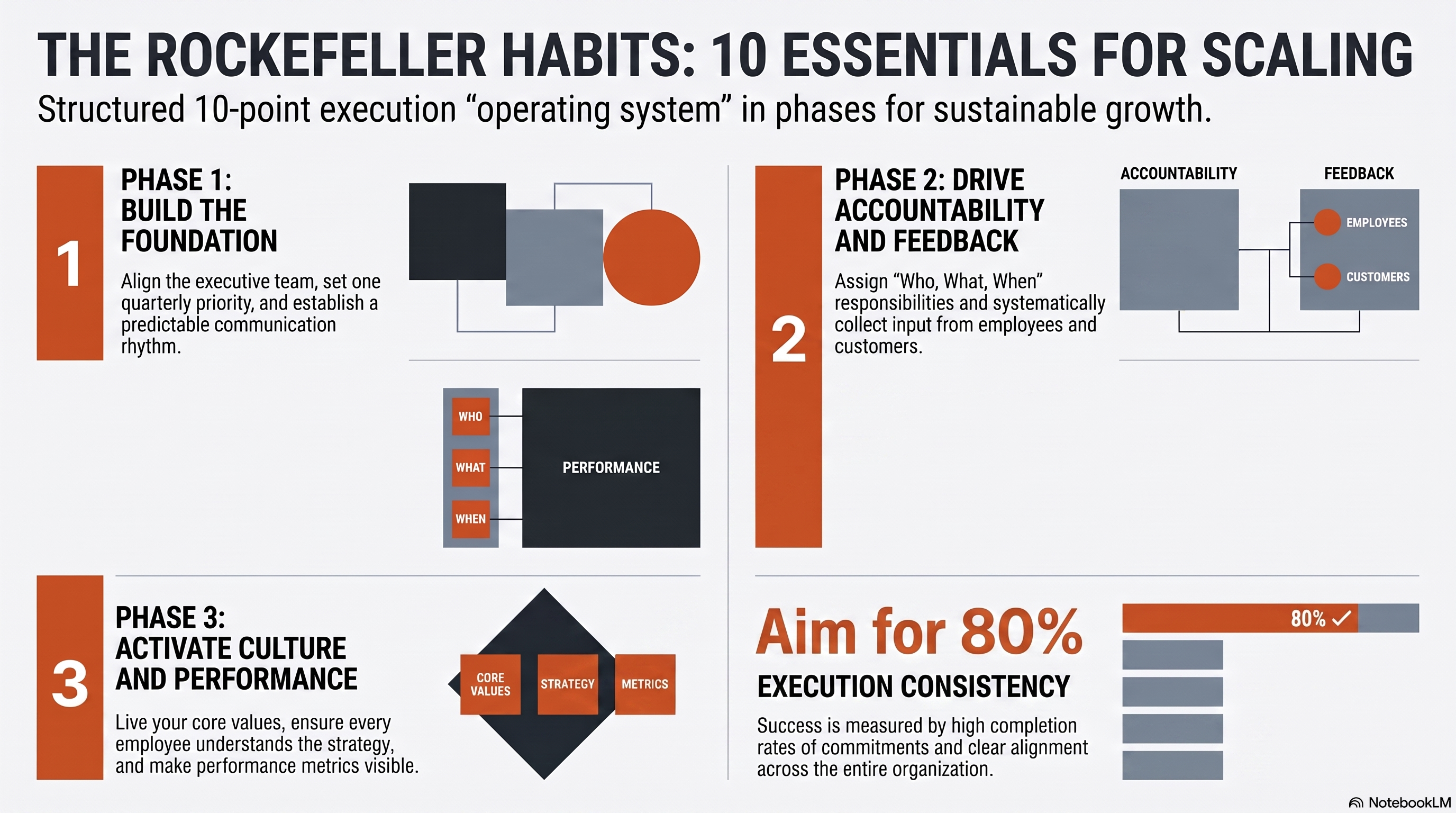
Phase 1 (Days 1-30): Foundation HabitsStart with habits 1, 2, and 3 – executive team health, quarterly themes, and communication rhythm. These create the foundation for everything else.
Phase 2 (Days 31-60): Accountability and FeedbackAdd habits 4, 5, and 6 – clear accountability, employee input, and customer feedback. These build on your communication foundation.
Phase 3 (Days 61-90): Culture and PerformanceImplement habits 7, 8, 9, and 10 – values activation, strategy articulation, performance measurement, and visible plans.
South African Implementation Considerations
Cultural Adaptation: Adapt the habits to fit South African business culture. For example, our consensus-building approach might mean longer discussion periods before decisions, but once decided, ensure clear accountability.
Resource Constraints: SA businesses typically operate with limited resources. Start with low-cost implementations – use free tools like Google Sheets for dashboards before investing in expensive software.
Regulatory Compliance: Ensure your performance measurement and feedback systems comply with South African labor law. When in doubt, consult with employment law experts.
Economic Volatility: Build flexibility into your habits. Your quarterly themes might need to adapt to economic changes, but the habit of having themes remains constant.
Common Mistakes That Kill Implementation
After working with hundreds of South African businesses, I’ve seen these mistakes repeatedly:
Mistake 1: The Perfection Trap
Waiting until you have the “perfect” system before starting. Start simple and improve over time.
Mistake 2: Leadership Inconsistency
Leaders who don’t follow the habits themselves. Your team will do what you do, not what you say.
Mistake 3: Over-Complicating Systems
Creating complex processes that require PhD-level understanding. Keep it simple enough that everyone can participate.
Mistake 4: Ignoring Cultural Fit
Implementing habits without considering your team’s cultural background and communication styles.
Mistake 5: Lack of Persistence
Giving up after a few weeks when you don’t see immediate results. Habits take time to develop – typically 90 days to see real impact.
Measuring Success: Your Rockefeller Habits Scorecard
Here’s how to track your progress across all 10 habits:
Monthly Scorecard (Rate each habit 1-10)
- Executive Team Health: Meeting attendance, decision speed, conflict resolution
- Quarterly Theme: Theme clarity, alignment percentage, progress metrics
- Communication Rhythm: Meeting effectiveness, information flow speed
- Clear Accountability: Commitment completion rates, issue resolution time
- Employee Input: Participation rates, implementation percentage
- Customer Feedback: NPS scores, retention rates, complaint resolution
- Values Activation: Employee awareness, decision alignment
- Strategy Articulation: Employee understanding, role clarity
- Performance Measurement: Target achievement, coaching frequency
- Visible Plans: Dashboard usage, transparency ratings
Overall Success Indicators
- Financial Performance: Revenue growth, profit margins, cash flow
- Operational Efficiency: Reduced firefighting, faster decision-making
- Employee Engagement: Higher satisfaction scores, lower turnover
- Customer Satisfaction: Improved NPS, increased referrals
- Leadership Effectiveness: More time for strategic work, less stress
Your Next Steps: Getting Started Today
Don’t let this become another article you read and forget. Here’s your action plan:
This Week:
- Assess your current state using the scorecard above
- Choose your first quarterly theme
- Schedule your first weekly leadership team meeting
This Month:
- Implement daily huddles with your team
- Create your first “Who, What, When” accountability tracker
- Send your first employee feedback survey
This Quarter:
- Implement all 10 habits systematically
- Measure progress monthly using the scorecard
- Adjust and improve based on what you learn
The Bottom Line: Execution Excellence Drives Growth
Here’s what I want you to remember: the Rockefeller Habits aren’t just about better organization – they’re about creating the foundation for sustainable growth. When you implement these habits consistently, you’ll notice something remarkable happening:
- Decisions get made faster
- Problems get solved before they become crises
- Your team becomes more engaged and productive
- Customers notice the improved service
- You finally have time to work on your business instead of just in it
The companies that master these habits don’t just survive – they thrive, even in challenging economic conditions. They become the businesses that other entrepreneurs admire and want to emulate.
Ready to Transform Your Business Execution?
The Rockefeller Habits have helped thousands of businesses worldwide scale successfully. Now it’s your turn to join them.
Remember, you don’t have to implement everything perfectly from day one. Start with one habit, master it, then add the next. Consistency beats perfection every time.
Your business has incredible potential. The question isn’t whether you can grow – it’s whether you’ll build the execution foundation to support that growth.
The choice is yours. Will you continue juggling flaming torches, or will you build the systems that let you focus on what really matters – growing your business and serving your customers?
Need help with implementation? Book a free strategy session to discuss how these habits can work specifically for your business.
Want to learn more about scaling your business?Check out our Complete Guide to Verne Harnish’s Scaling Up Methodology for South African Businesses.
About the Author: This article draws from years of experience helping South African businesses implement proven scaling methodologies. The Rockefeller Habits framework is based on Verne Harnish’s research and the principles outlined in his book “Scaling Up.”
Topics Rockefeller Habits, business execution, scaling up, business growth, South African business, execution framework, business management, growth strategy
Ready to tackle these challenges?
Let's have a conversation about where you are and where you want to go.
Book a Conversation